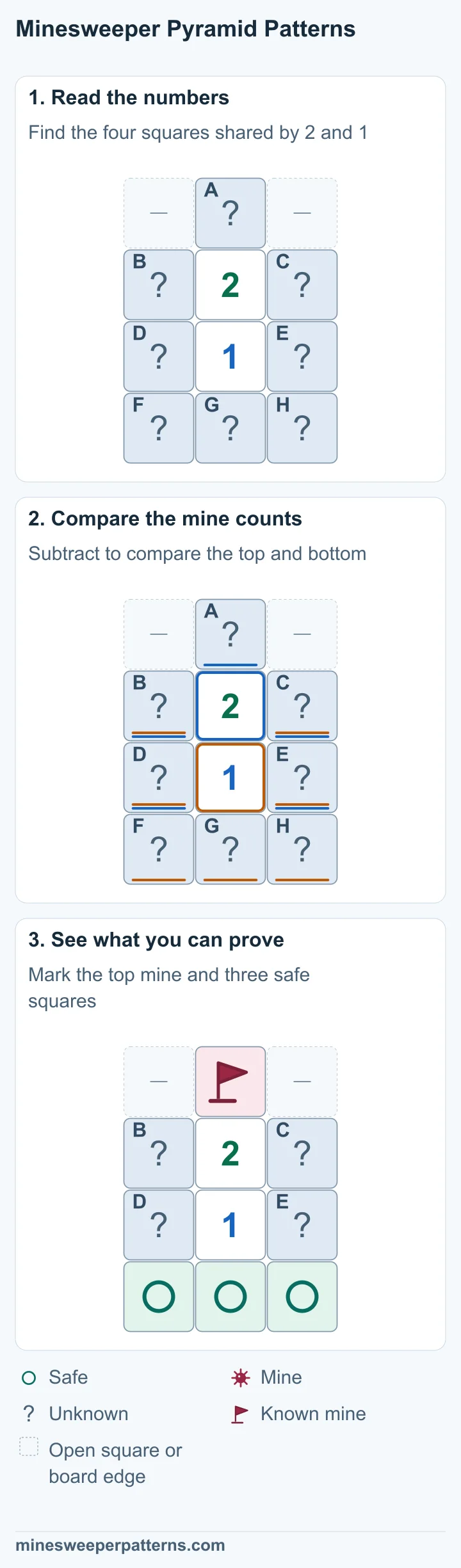
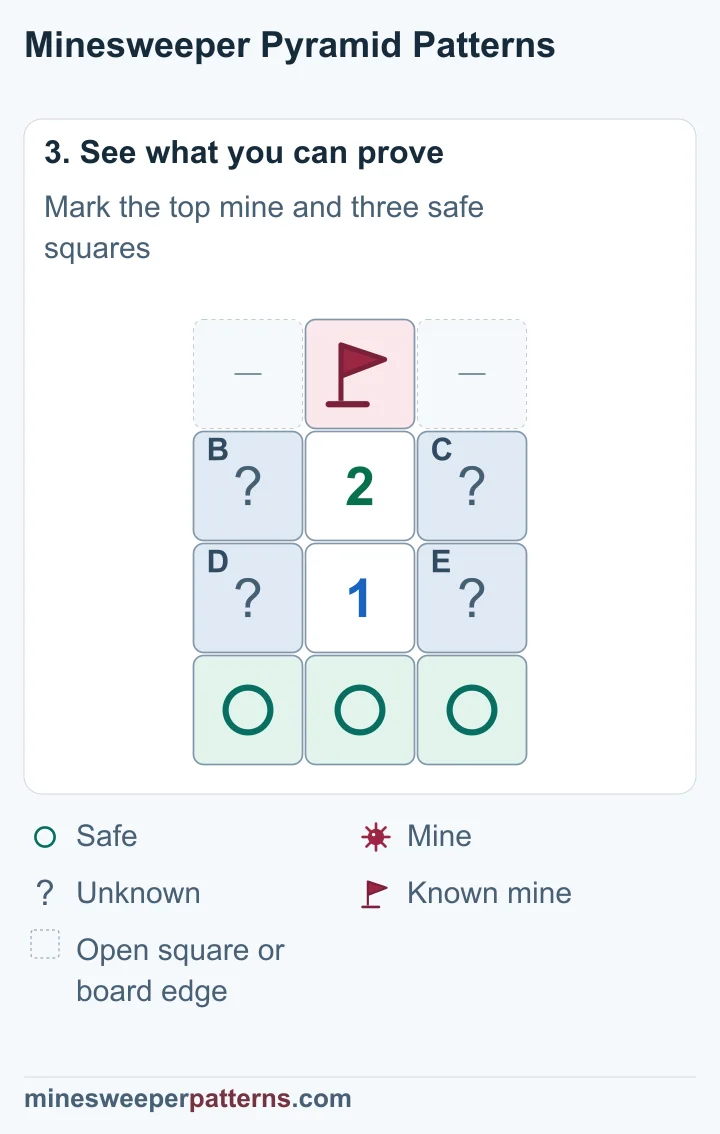
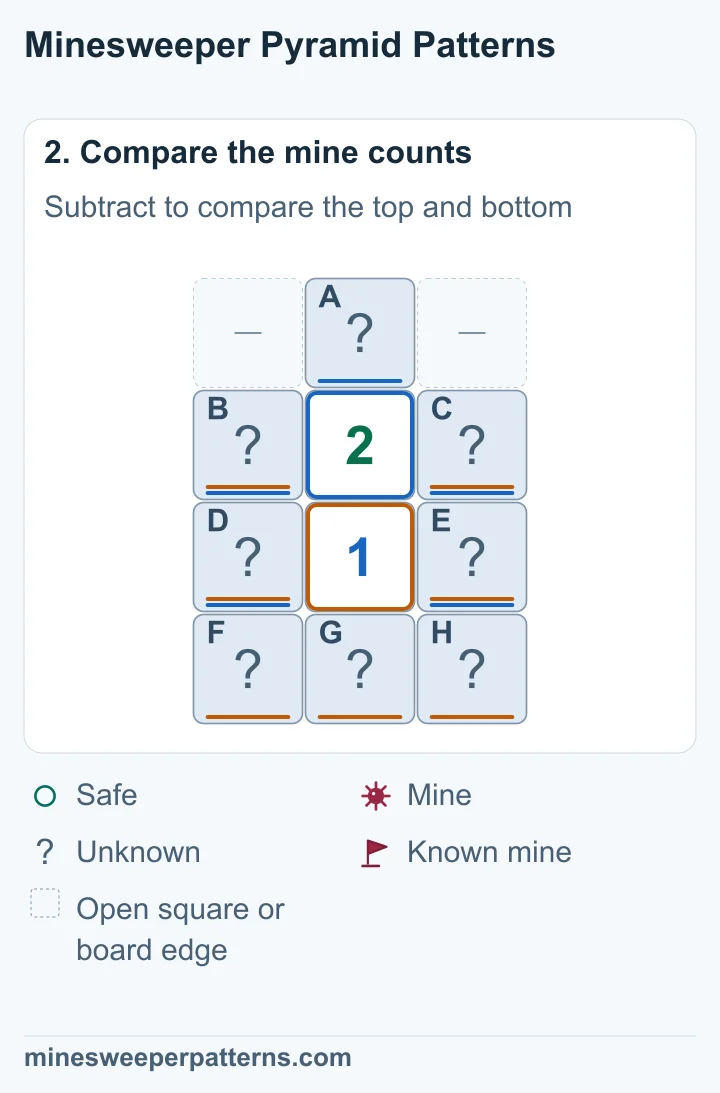
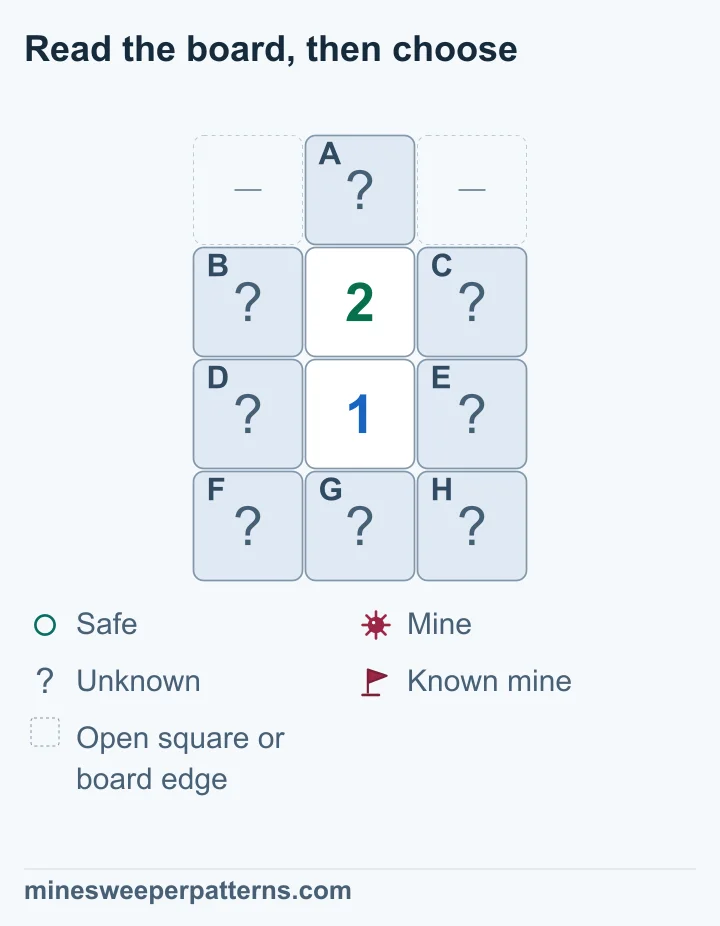
A 2 sits above a 1. One covered square forms the top point, with three covered squares along the bottom. The top point has a mine. The bottom row is safe.
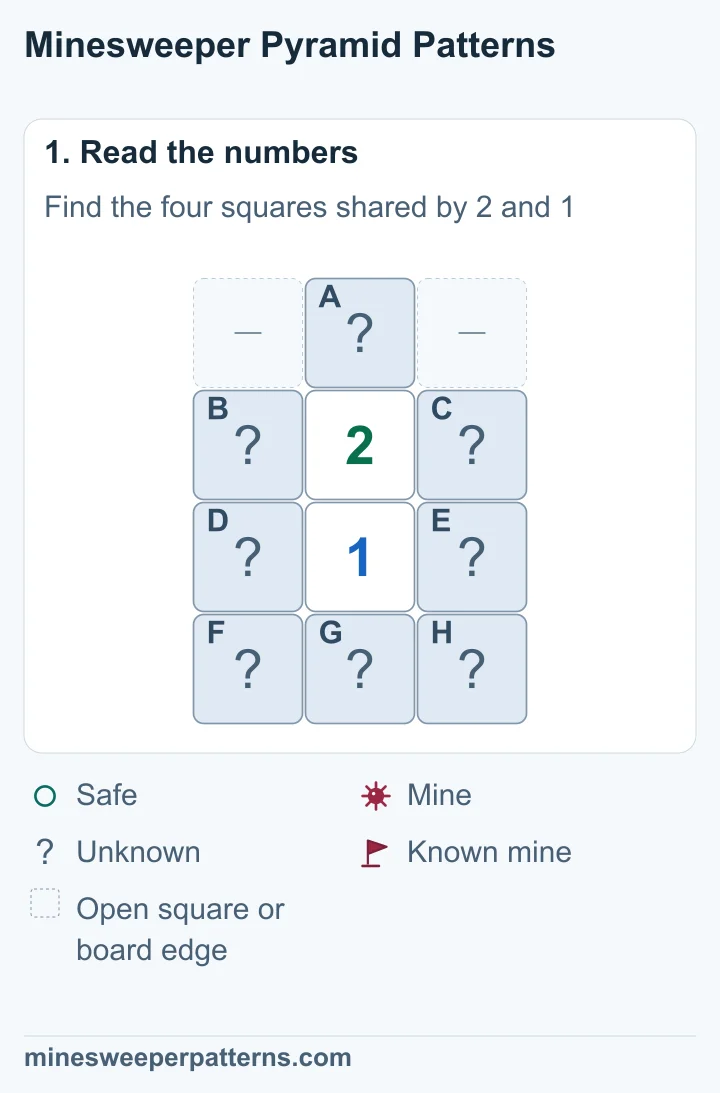
The upper clue gives A + B + C + D + E = 2. The lower clue gives B + C + D + E + F + G + H = 1. Subtracting gives A − (F + G + H) = 1.
Before
After
Why it works
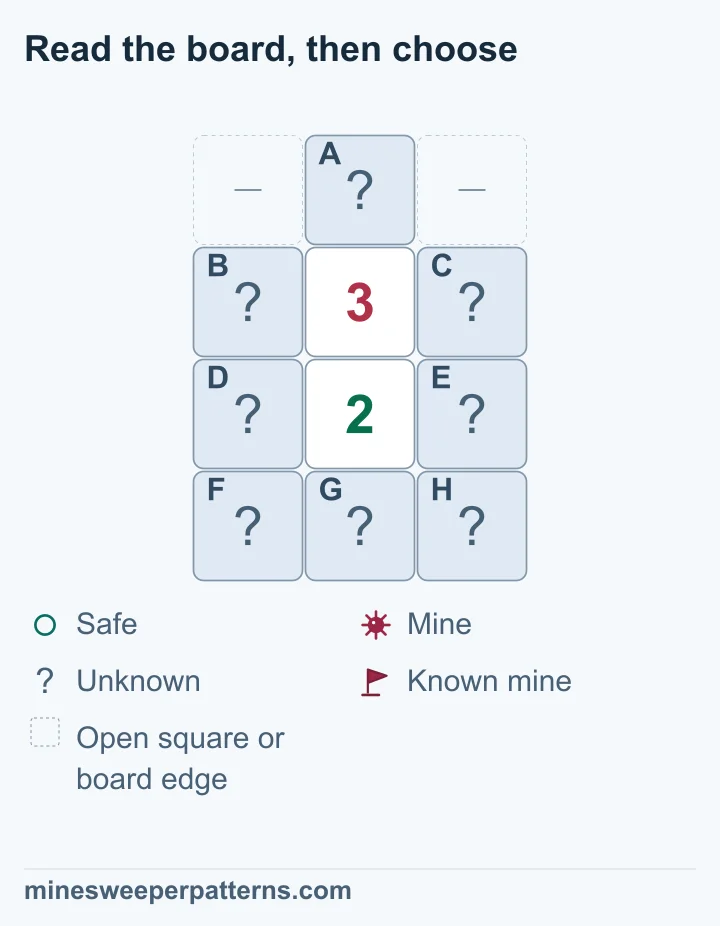
A can hold at most one mine. The equation therefore requires a mine in A and no mines in F, G or H. One mine remains among the four shared squares. A 3 above a 2 gives the same top and bottom results, with two mines in the shared group.
The rule
Both clues touch the same four unknown squares at their sides. The 2 also touches A at the top point. The 1 also touches F, G and H in the bottom row.
What to check
There must be just one unknown square that touches the upper clue alone: the top point. The four side squares touch both clues. The three bottom squares touch only the lower clue. Check all three groups.
Both clues touch the same four unknown squares at their sides. The 2 also touches A at the top point. The 1 also touches F, G and H in the bottom row.
AB2CD1EFGH
Choose a covered square. Then decide whether it is safe, has a mine, or needs more information.
Why this answer is correct
A: Mine · B: Not enough information · C: Not enough information · D: Not enough information · E: Not enough information · F: Safe · G: Safe · H: Safe
The shown covered squares are the only unknown squares around these numbers. Gaps stand for open squares or the board edge. Check every nearby square before you apply the result. Flags in these examples mark known mines.
Try the same idea with other numbers
Read the board, then choose
Try the same idea with other numbers
AB3CD2EFGH
Choose a covered square. Then decide whether it is safe, has a mine, or needs more information.
Why this answer is correct
A: Mine · B: Not enough information · C: Not enough information · D: Not enough information · E: Not enough information · F: Safe · G: Safe · H: Safe
The shown covered squares are the only unknown squares around these numbers. Gaps stand for open squares or the board edge. Check every nearby square before you apply the result. Flags in these examples mark known mines.
Privacy
Your game records stay in this browser on this device.